Shielding guide
MRI RF Shielding Requirements: What Imaging Suites Actually Need
An MRI room is shielded to keep outside radiofrequency noise away from the scanner, not to contain anything inside. The enclosure wraps every surface, and every service entering the room passes through it on the shield vendor's terms.
Why an MRI room is shielded at all
MRI works by pulsing radiofrequency energy through the patient inside a strong magnetic field, then detecting the faint energy released when that pulse stops. Any ambient radio noise that reaches the scanner competes with the signal it is trying to read. [2]
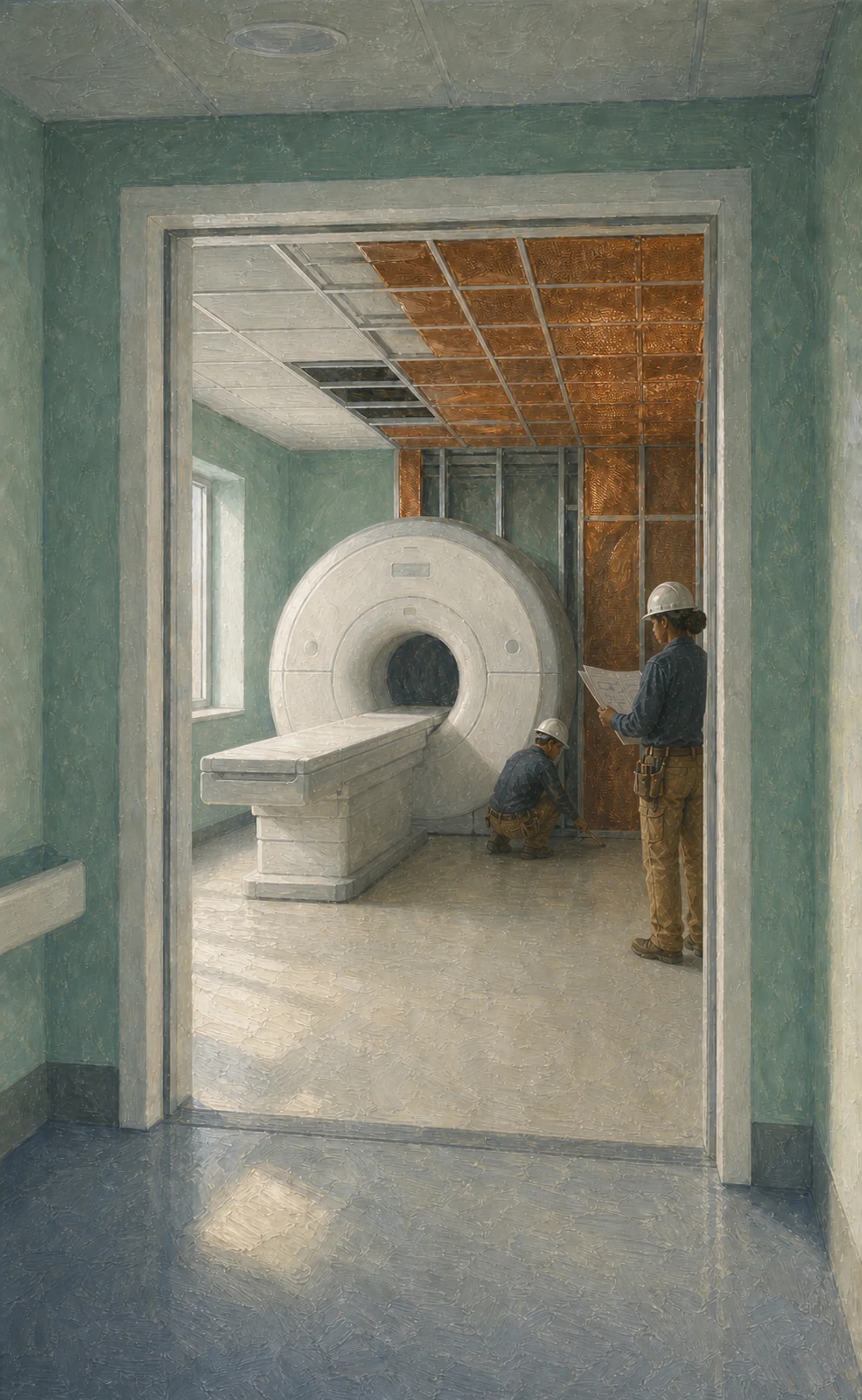
That is why nearly all clinical MRI scanners require RF shielding that is continuous across all six surfaces of the room: walls, ceiling, and floor. Unlike X-ray shielding, the RF enclosure contains nothing from the scanner. Its one purpose is keeping external radiofrequency noise out of the room, where it could corrupt images. [1]
What the enclosure is made of
Typical RF enclosures are copper foil panels bolted together, or galvanized sheet metal sandwiched over a particleboard substrate. The assembly is not designed to a generic number: it must be warranted to meet the minimum RF attenuation criteria established by the MRI system manufacturer for the specific machine being sited. [1]
The practical consequence for a project team is that the shielding subcontract is machine-specific. A room built ahead of the scanner selection is a room that may need rework, which is why the shield vendor, the equipment vendor, and the design team coordinate from early planning. [1]

Every penetration is a waveguide
A continuous shield is only as good as its openings. Services entering the MRI room, including ductwork, lighting and power circuits, sprinkler piping, and medical gas, must pass through specific penetrations called waveguides, coordinated with the RF shield vendor to the MRI manufacturer's recommendations. [1]
Doors, frames, window lites, and hardware set into RF-shielded partitions are typically provided by the shield vendor as well, because each one must maintain the enclosure's rated attenuation. Trades that normally cut their own openings lose that freedom in this room. [1]
RF shielding is not magnetic shielding
Projects often carry a second, distinct scope: passive magnetic shielding that contains the magnet's fringe field, drawn on plans as gauss lines. Where RF shielding must wrap every side of the room, passive magnetic shielding is typically steel plate and can be localized to the surfaces that need it. [1]
Suite planning also follows the ACR four-zone model of sequential access restriction, with the scanner room as the most controlled zone. Zone layout, fringe-field containment, and RF attenuation are three separate design questions that a qualified team resolves together. [1]
Where the scope lands in the schedule
The RF enclosure is erected and acceptance-tested before the MRI system is delivered and before interior finishes are complete. The shield includes a removable section for magnet delivery, and after the scanner is inside and the shield is closed, the assembly is tested again before finish walls and ceilings close it in. That sequencing places the enclosure ahead of both equipment installation and finishes, which makes it a mid-construction package rather than a fit-out item. [1]
The Longlead connection
How Longlead AI helps
Longlead AI reads dated public records and surfaces projects that may create demand for a specialist's scope, often before that scope is named in the record. Every opportunity carries its source, and where the record supports one, an estimated lead-time window derived from that project's own signals rather than a headline number. Longlead prepares a cited qualification brief that names the likely counterparty where the record identifies one; the customer makes the call from its own channels, and nothing leaves the system.
Official sources
- [1]PG-18-12 Imaging Services Design Guide (Chapter 295)U.S. Department of Veterans Affairs, Office of Construction & Facilities Management
- [2]Magnetic Resonance Imaging (MRI) — science topic overviewNational Institute of Biomedical Imaging and Bioengineering, NIH
FAQ
- Does an MRI room need to be shielded?
- Nearly all clinical MRI scanners require RF shielding that is continuous across the room's walls, ceiling, and floor. The shielding keeps external radiofrequency noise out of the scanner room, where it could corrupt images.
- What is MRI RF shielding made of?
- Typical enclosures are copper foil panels bolted together, or galvanized sheet metal over a particleboard substrate. The assembly must be warranted to meet the attenuation criteria set by the MRI manufacturer for the specific machine being installed.
- What is the difference between RF shielding and magnetic shielding?
- RF shielding blocks outside radio noise and must wrap all six surfaces of the room, while passive magnetic shielding contains the magnet's fringe field and can be localized steel plate. They are separate scopes that often appear on the same project.
- Who sets the shielding specification for an MRI room?
- The RF attenuation criteria come from the MRI system manufacturer, and the shield vendor executes and warrants the enclosure to that spec. Radiation shielding on the same project is specified separately by a credentialed medical or health physicist.